Sunday, August 7, 2016

August 5 report

Earlier this week I updated one of my favorite astronomy software programs Deep-Sky Planner to version 7.  I've used this program for several years to plan my observing sessions and to record my observations.   I find the program exceptionally easy to use, full featured, reliable, regularly updated, and very well supported.   I've considered writing a review, but I've found that Rod Molise has penned very good reviews on his blog and in Sky & Telescope  magazine July 2015. If you don't use planning software or if you use a different program, give Deep-Sky Planner a look.

Aug 5 - A very warm & humid night but after an afternoon thunderstorm the skies are remarkably clear. Only a few spotty clouds. The rain cooled off the temp (it is 78 now at 2100 hrs). Mosquitoes are thick and I have the Thermocells going but I've already been bitten once.


My plan was to work on a drift alignment of the mount.  Since mounting my G-11 on the pier in the observatory I've used the polar scope to align, but I do observe image shift between 90 second exposures.  For this setup I'll used my Mallincam with no focal reducer or Barlow.
I followed the instructions written by Ray Shore and posted on AstroPhotography Tonight.  This was my first attempt at drift alignment and I approached it tentatively, making small adjustments, measure the drift, tweak some more, remeasure the drift, etc, etc, etc...  I did find settings that resulted in no perceptible drift for over 5 minutes, but after aligning the altitude and returning to check the azimuth, the drift had returned.  This back & forth went on for hours and frankly I'm not so sure that my final alignment is any better than when I started.   I'll revisit this process at my next observing session and hope to home in on a more stable alignment for my mount.

Sunday, July 24, 2016

July 16 Observing Report

July 16 was a hot, humid, but clear night.  Some clouds were present in the east but the sky was mostly clear with no star twinkle evident.  Sky meter reading at 11:30 pm was 18.24 mpsas or 4.17 nelm.   I spent some time trying to capture a decent image of Mars and Saturn but the planets were dancing such that a crisp focus was not possible.   This is the best I got with my VRC-10 operating at its native F8 and with a Televue 2" 2X Barlow lens bringing the optics to approximately F16.


The seeing South Louisiana in the summer is not great.  So I will keep trying, hoping for a night with clear skies and stable atmospheric conditions before Mars & Saturn fade into the west until next year.

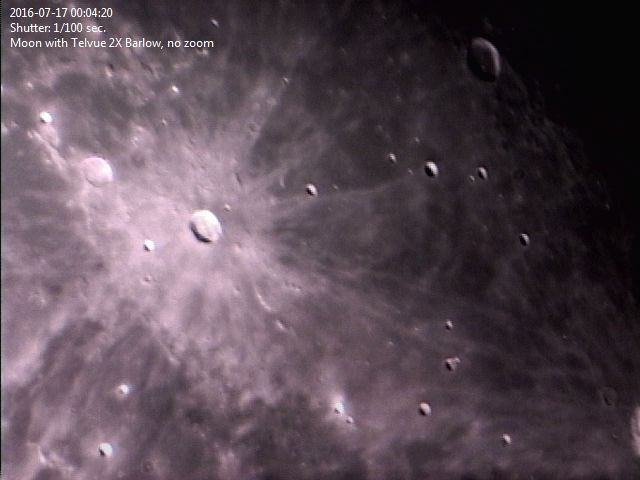
I did enjoy some lunar viewing.  At F16 the moon's violent history is nicely revealed.  Even some craters house craters.   I'm not a lunar maven so I'm not sure of the surface location of these images.


In more recent nights, the sky has been largely cloudy such that even the the full moon is partially or even fully obscured.  So for now my telescopes sleep, dreaming of clear skies.


Tuesday, July 5, 2016

July 4 Observing Report

After the hamburgers and hot dogs were consumed and darkness fell, Heather and I slipped out to the observatory for a quick viewing session. Heather discovered she only had 6 Messier objects left to observe and they were the ones in Scorpius & Sagittarius we had looked at on July 1 but she had neglected to log them. So on a hot, humid, but clear night with decent seeing (no star twinkle and no planets dancing in the eyepiece), we observed Messier 4, 6, 7, and 80. By 10:00 pm Sagittarius was high enough for her to see Messier 69 & 70 at the base of the “tea pot”, and she was done! We capped off the evening by taking a quick look at M57 & M13, and then called it a night.  I checked the sky quality at 22:40 and got a reading of 18.78 mpsas or a limiting magnitude of 4.60 and a temperature of 81 F.

Congratulations to Heather for completing her observations of the Messier objects!

Sunday, July 3, 2016

July 1 Observing Report

My daughter Heather came over around 10 to view on a hot and humid night . I threw in my polar scope and adjusted my polar alignment as my go to  & tracking has been off. It was pointing a bit low and to the SE. As Heather was over, I didn't take the time to drift align as I have been meaning to do, but instead jumped into viewing.

We started with Saturn and despite the humidity and high temps, we were rewarded with unexpectedly decent, but not good, seeing. While surface features weren't clear other than 1 equatorial band, we could detect a graduation in the brightness of the clouds from the pole to equator we also could detect the Cassini division between the A & B rings. At first we weren't sure we were seeing it, but as the seeing improved the dark band ~ 2/3 out the ring from the planet became prominent. With a 2.5X Powermate and 11mm eyepiece (EP) the focus became a bit soft but not bad, but the 11 mm EP provided the best views.

We then embarked on a mini-marathon of almost all of the Messier objects in Scorpius, Sagittarius, Ophiuchus, Lyra, Hercules, and Cygnus. We tried the Trifid and Lagoon nebulas but they were nearly imperceptible from the background in our mag 4.5 skies. So we focused on the star clusters, of which there are many in this area of the sky. Messier 13 & 5 were especially nice. At my scope's native F8, I found an 11mm EP provided the best balance of image scale and detail. At F10 Heather was using 15 mm and above EP.  Comparisons between the two scopes were virtually identical. At a bit after 1 am we called it a night and closed up the observatory.


My adjustment to the polar alignment seemed to help but I still need to drift align.  A fun night under the stars.   

Texas Star Party - Nope, not this year

I've been hoping to attend the Texas Star Party for several years now, but other priorities kept us from it.  2016 was to be the year and as luck would have it, on March 10 we were selected to attend and awarded a spot for our RV!   We plan to attend for the full week to get the most out of the experience.  In planning the 944 mile trip (by far the longest trip we have ever made pulling a trailer) I decided to limit travel to about 4 hours per day.


So we planned to travel to Beaumont, Texas on Day 1, then onto San Antonio on Day 2.  Day 3 brings us to Fort Stockton, Texas, only about 1-1/2 hour from Fort Davis and the star party.   So a 4 day trip each way plus 7 days at the star party, a 13 day trip !  Downsides are that the timing would require us to leave on April 28, our eldest daughter's birthday and also we will be away from home on Mother's day, so my wife will miss having the day with the kids and grand kids.

It was a big job to tear down the scope and empty the observatory and pack it into the back of my truck.  I was worried it might not all fit, but it did.


The hatch even closed !

The trailer was packed and ready to go.   Ok, I did need to pull in the slide and and fold up the steps.


As April 28 came, the weather forecast wasn't looking good through Texas or Louisiana.  I didn't look forward to hauling the trailer in hard rain and especially high winds.  We decided to postpone leaving for a couple of days to allow the threat of severe weather pass.   Besides the weather forecast for the Star Party calls for rain on Sunday and Monday, so I likely will not miss any observing time by arriving on Tuesday.

As Saturday came, the weather didn't improve and the forecast for Sunday wasn't any better.  Monday looked like it might be an OK travel day but that would have us arriving Wed night, IF I could make it in 3 days.  Would I have the stamina to drive all day and set up and then view?.  Six  travel days for 3-4 nights viewing, assuming good weather at the Prude Ranch, is not a good ratio for such a long journey. So we reluctantly decided to cancel the trip for this year.  On a positive note we will still get to attend a star party: the Deep South Spring Scrimmage.  It is only 1-1/2 hour drive away and the weather forecast looks promising.  Hey, the truck and trailer are already packed !

This post was written on May 3-4, 2016 but I overlooked posting it until now. 

Saturday, May 14, 2016

Losmandy G-11 RA & Dec extension kit

One of the challenges with the Losmandy G-11 mount is that when tracking past the meridian, the saddle plate can impact the RA motor.   To mitigate this issue, at least partially, Losmandy offers a RA Extension kit.  This kit adds 1.5" to the RA body and also raises the Saddle Plate by 0.6".  I've had the kit sitting in the box for months. While setting the scope back up after returning from the Deep South Spring Scrimmage seemed like the perfect time to install this kit.

As one would expect, the fit and finish of all parts was excellent.  The installation was very easy and took only a few minutes. I've posted pictures of the install to my FLICKR account.   Despite the extended appearance, the mount is still rigid.  I had to wait a few days to test the mount due to weather.  The mount performed flawlessly and I enjoyed being able to track well past the meridian without colliding with the mount.  An excellent addition to my mount.  In my opinion, this option should come standard on the mount.

Sunday, March 27, 2016

My Favorite Red Lights

One of the first accessories that most amateur astronomers pick up is a flashlight with a red bulb and/or red filter to preserve their night vision.  I have a variety of  red lights.  Some are basic flash lights designs and some are small clip on lights that fit on the brim of a cap.  These are very handy when working on the scope as they aim the light directly at what you are working on.  But where I struggled was a having a little bigger battery powered light for reading finder charts and star atlas while observing.  My wife stumbled across a light she thought I would like and bought me a couple of the Beam n Read ® LED 6 Hands-Free Pilots Night Vision Light.  They have quickly become one of my favorite red lights.


  This light has 6 red LEDs plus a red filter and runs off of 4 AA batteries.  The light is bright enough to read with but is not overly bright.  It has a strap to wear the light around your neck, but I rarely do so.  I prefer a light mounted on the brim of my cap when working, but when reading this light is great.  It has two positions to illuminate the right spot.


These lights are also available from Amazon.

-------------------------------------------

As I said earlier, when working at the scope I like a red light mounted on the brim of my cap.    I've tried several such lights and the one I like the best is the Bushnell H65L.  This little light has red and white lights, as do many such products.  However what I like about this one is it has separate switches for the red and white lights and the red light switch is on the Right !  So I can avoid blinding myself or others at star parties by hitting the wrong switch.  Even I can remember Right = Red.


The light is small and lite so it won't weigh down  your hat.

The light also tilts so you can point it directly at what you are working on.

I'm sure these are available at many places but I got mine at Walmart.

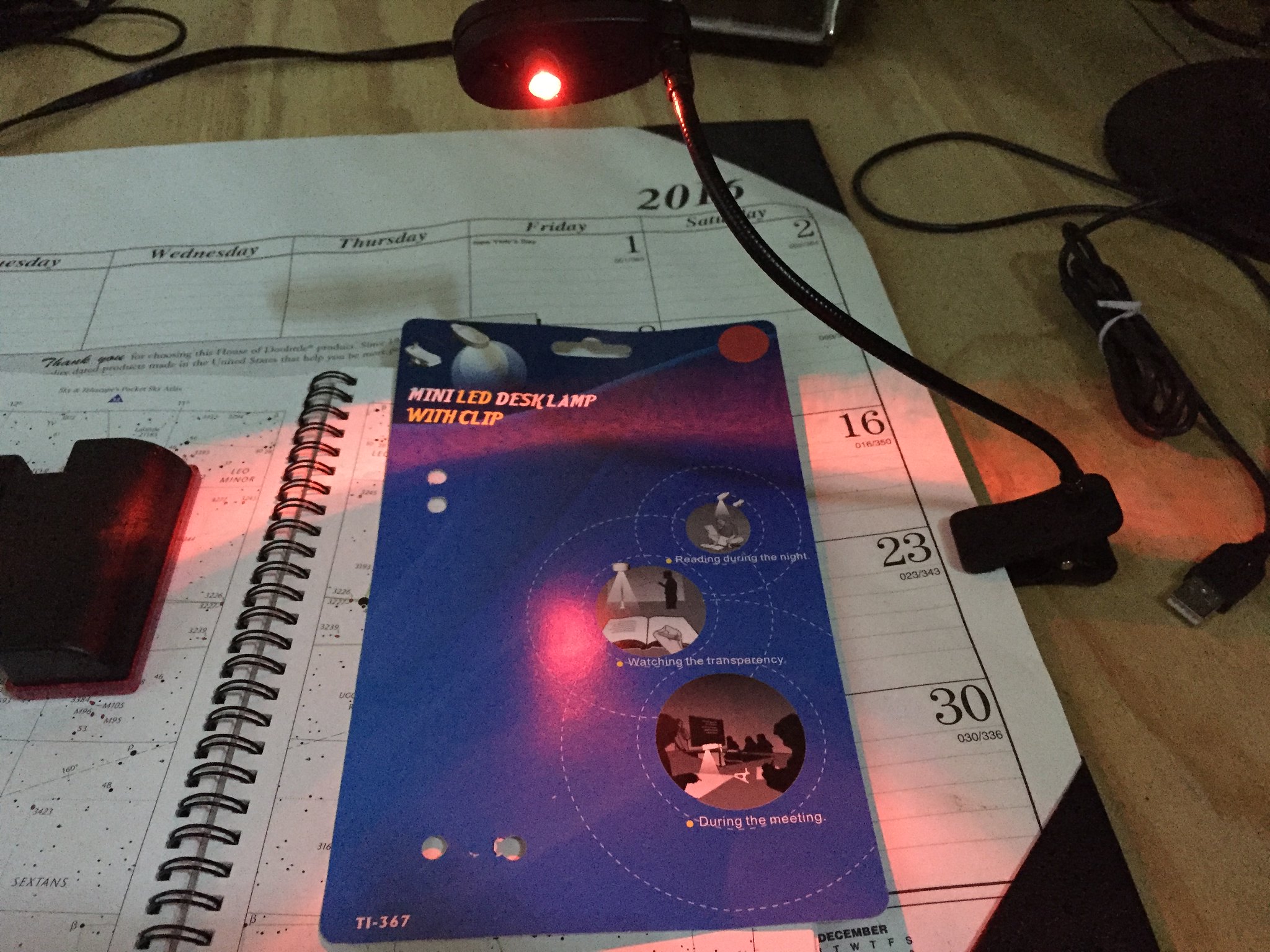
The last light I'll share is one that my wife picked up for me from Amazon.  These flexible neck, clip on, red lights are small and very flexible so you can position the light right where you need it.


 I do find the illuminated spot to be quite small so to read a star chart I have to move the light around.  For reading star charts or books I prefer the larger 6 LED light discussed above, but I'm sure I'll find use for these as well.


If you are in need of a red light, give one of these products a try I think you will enjoy them.